Train or plane in Europe? Do the door-to-door maths first
How to compare train and plane trips in Europe on real door-to-door time and carbon, with figures from the EEA, Our World in Data and Eurostar.
Flight time is the number everyone quotes and the one that matters least. Here is how to compare rail and air in Europe honestly, on hours and on carbon, using published figures.
By Traviology · Published 2026-11-28
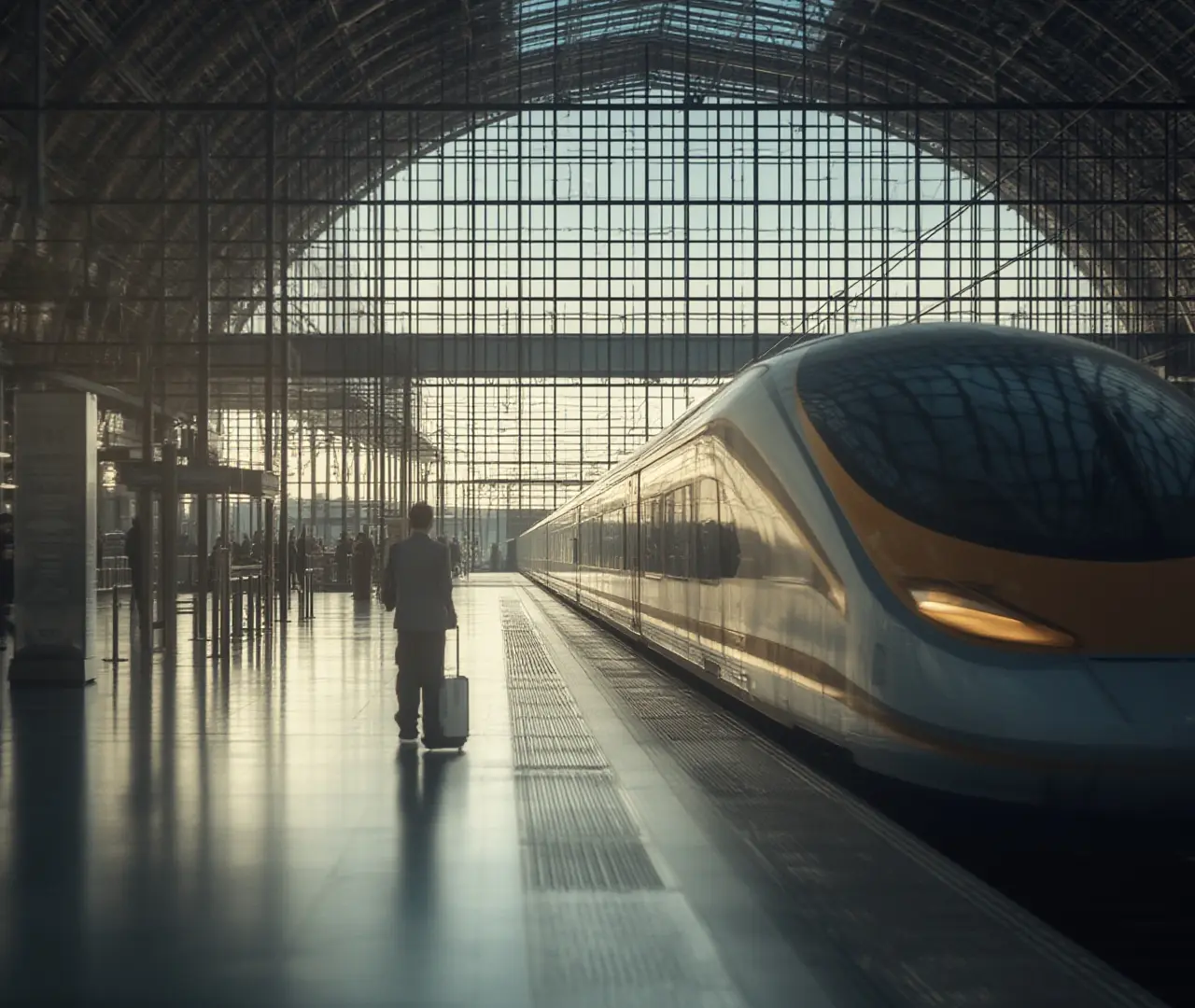
A client asks whether to fly or take the train between two European cities. The airline says 1 hour 10 minutes. The rail operator says 3 hours. Most people stop there and book the flight.
That comparison is broken before it starts. One number is gate to gate. The other is centre to centre. To give a straight answer you need both trips measured the same way, from the hotel door to the next hotel door.
Why flight time is the wrong number
The European Environment Agency made the same point in its 2020 report on rail and air. Flying is only part of an air trip. Add the ride to the airport, check-in, security and the wait at the baggage belt, and the clock looks different. The report also says people find that extra time more bothersome than the flight itself.
Rail has penalties too. The same report says time on board can be much longer, and that changing trains bothers people more than simply sitting on one. What you skip is the separate check-in, the security queue and the baggage hall. Stations also tend to sit closer to where people actually want to be, though that depends on the hotel.
A worksheet that takes five minutes
For each option, write down five things and add them up:
Getting there. Hotel to airport or station, using the real transfer time for that hour of day.
Buffer. The arrival time the airline or operator asks for, not the one your client hopes for.
In motion. Scheduled flight or train time.
At the other end. Taxiing, deplaning and bags for a flight; walking off the platform for most trains.
Getting in. Airport or station to the next hotel.
Put the two totals side by side, then add one more column: what the client can actually do during each block. Two hours at a table with phone signal isn't the same two hours as standing in a security queue.
One route with published numbers
London to Paris is the textbook case because the operator publishes the parts clearly. Eurostar says most of its London to Paris trains take 2 hours 16 minutes, with some taking up to 2 hours 37 minutes, city centre to city centre.
The buffer isn't zero, though. London departures involve ticket, security and border checks before boarding, and Eurostar now notes these can include Entry/Exit System registration. Ticket checks close 30 minutes before departure for Standard and Plus, and the company asks travellers to arrive at the time printed on their ticket, not just before the gates shut. The upside: because the border checks happen before departure, passengers can walk straight off the train in Paris.
Off that route the buffer shrinks. For travel between Germany, the Netherlands, Belgium and France, Eurostar suggests arriving about 20 minutes before departure, and for TGV INOUI and TGV Lyria trains it asks for at least 20 minutes. Now fill in the flight side of the worksheet for the same day. The gap is often much smaller than the headline numbers suggest.
Where rail tends to win, and where it stops
The EEA report summarises research finding that high-speed rail is a good substitute for flying on trips of up to about 2.5 to 3 hours, and less so beyond that. It also cites work showing that where high-speed rail takes up to about 3.5 hours, it can hold half or more of the combined rail and air market.
Over longer hops, roughly 800 to 1,200 km, the report points to night trains. The hours don't feel wasted, because the client isn't paying for a hotel that night. Good pitch for the right traveller. Bad pitch for someone who sleeps badly on the move.
The carbon side, without the guilt trip
Our World in Data, using UK government emission factors, puts a domestic flight at about 246 grams of CO2-equivalent per passenger-kilometre and national rail at about 35 grams. That works out to roughly 86% less for the train. Its example for Eurostar is starker: about 4 grams per passenger-kilometre against 154 grams for a short-haul flight. Those aviation figures include a multiplier for the extra warming effect of emissions at altitude.
Two caveats before you pass these on. These are averages, for a start: the EEA's comparison assumed aircraft about 80% full, high-speed trains 66% and intercity trains 36%, and a fuller or emptier vehicle changes the result. And flying isn't always the worst choice. The EEA found one person driving a petrol or diesel car alone can be more harmful.
How to say it to a client
Keep it short. "The flight is faster in the air, but door to door it's closer than it looks. Here are both totals. The train also has a much smaller footprint per person." Then let them choose. Some will still fly, and that is fine. They are choosing with the full picture.
If you quote rail legs alongside flights, our trains page shows how they sit together in a Traviology itinerary.
Sources
Transport and environment report 2020: Train or plane? (European Environment Agency, Report 19/2020)
Which form of transport has the smallest carbon footprint? (Our World in Data, updated 2023)
What time should I arrive at the station? (Eurostar Help Centre)
Timetables and arrival advice checked October 2026.
See it on your brand
Flights, hotels, trains, transfers, and tours, sold under your name. One short walkthrough, then you decide.