What plugs into a Traviology storefront, and why your team will notice
A plain guide to what connects to a Traviology storefront: supplier inventory, Stripe Checkout, Google Places and Sign-In, Cloudflare, and your own APIs.
Supplier connections, Stripe payments, Google location search and sign-in, and Cloudflare delivery come wired in, and Enterprise teams can add their own supplier APIs. Here is what each one changes at the desk.
By Traviology · Published 2026-10-10
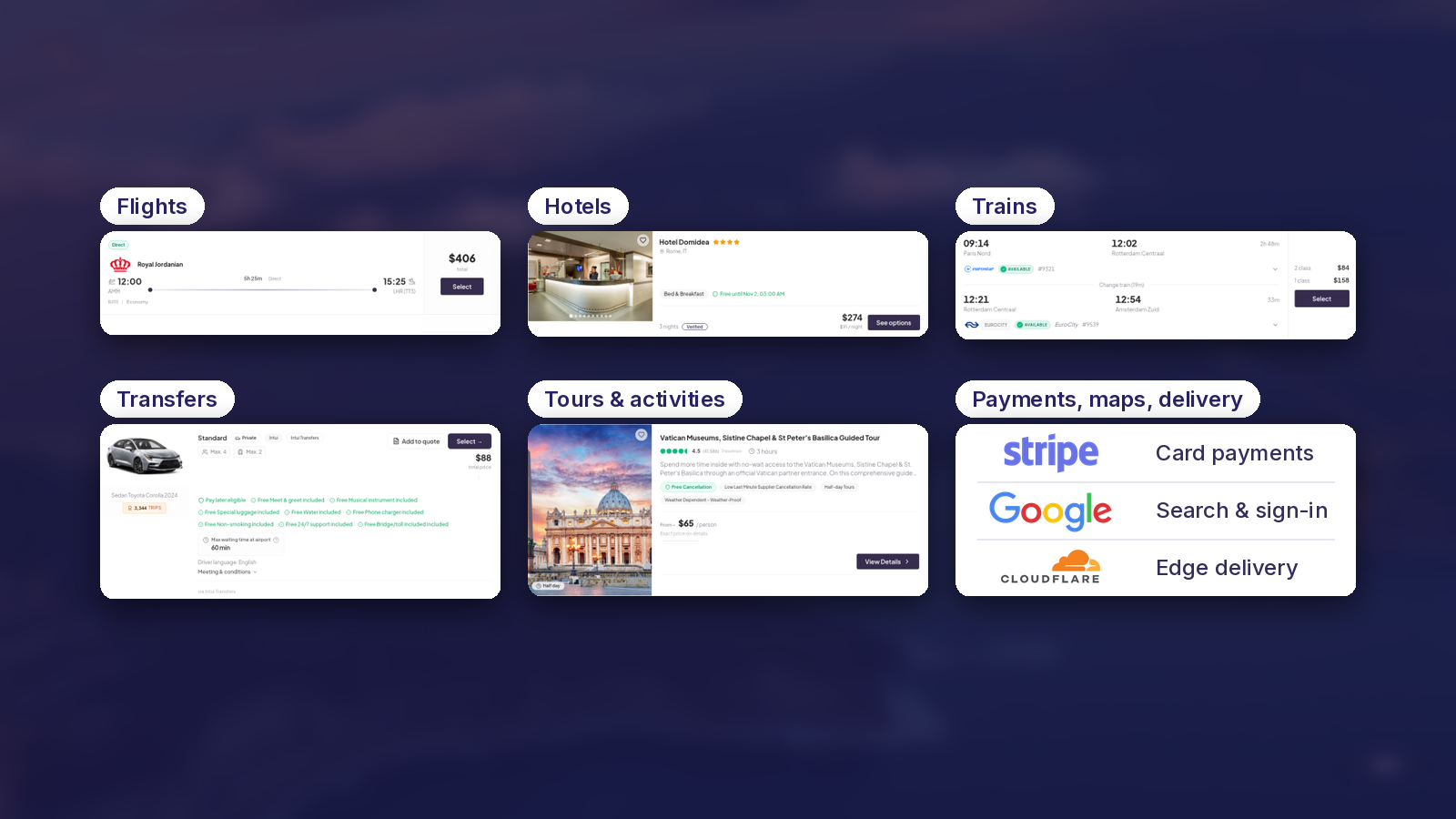
An integrations list usually reads like a logo wall. That doesn't help when you're deciding whether a platform will make Monday morning easier. So here's what connects to a Traviology storefront, grouped by the job it does, with the part your team actually feels.
Inventory: what you can sell
Every active bundle includes Traviology's built-in supplier integrations, which consolidate hotels, flights, transfers, tours and trains into one search. You don't pick or contract the sources one by one; the plans page lists them simply as part of what's always included.
What you notice: you can sell from day one. There's no supplier contract to negotiate first. The content lands in one search under your brand.
Your own contracts sit beside this. Local inventory lets you publish hotels, transfers and tours with seasonal pricing, sold next to API results or on their own, though flights and trains stay API-only.
Your own supplier APIs
On Enterprise, you can connect your own hotel, flight, transfer, tour or rail API credentials and keep Traviology's booking engine, wallets, invoicing and storefront. Enterprise includes 4 custom integration slots for suppliers or back-office systems outside the standard stack, with more available for a fee. Own credentials aren't part of the Platform plan, and custom slots there are a conversation with sales.
Classic GDS connectivity with Amadeus, Sabre and Travelport is an Enterprise roadmap program, scoped with sales.
Payments
On every plan, Stripe Checkout runs card payments and wallet top-ups on your storefront, while invoicing, markup and refunds stay in your admin.
What you notice: the guest pays on your domain, and finance isn't reconciling a separate payment portal at month-end.
Location search and sign-in
Google Places powers location search across every product, so typing a city behaves the same in hotels, transfers and tours. Google Sign-In lets guests reach checkout without creating yet another password. Branding is optional.
Delivery
Storefronts, search and images are served from Cloudflare's edge, with custom domain verification and TLS for every tenant. The site is careful to add that latency varies by route, supplier and cache state. Fair enough.
Conversations
Live chat on the storefront has an agent inbox and queue. Agents away? TravioBot steps in as a fallback.
A quick way to decide
You want to sell fast without supplier paperwork: the included integrations cover it.
You hold negotiated rates: publish them as local inventory.
You already have supplier contracts with their own APIs: that's an Enterprise conversation.
The plans comparison shows which integrations come with each bundle.
The For Agencies page covers payments, maps, identity and edge delivery in more detail.