Your storefront now has a blog. Here's how to make it sell trips
Every Traviology storefront now has a free blog on your own domain: your brand, any language with full RTL, SEO basics built in and bookable Trip Ideas.
Every Traviology storefront now includes a free blog on your own domain, in your brand, in any language you sell in. Here is what it does, what it looks like live, and a simple first month for your team.
By Traviology · Published 2026-11-25
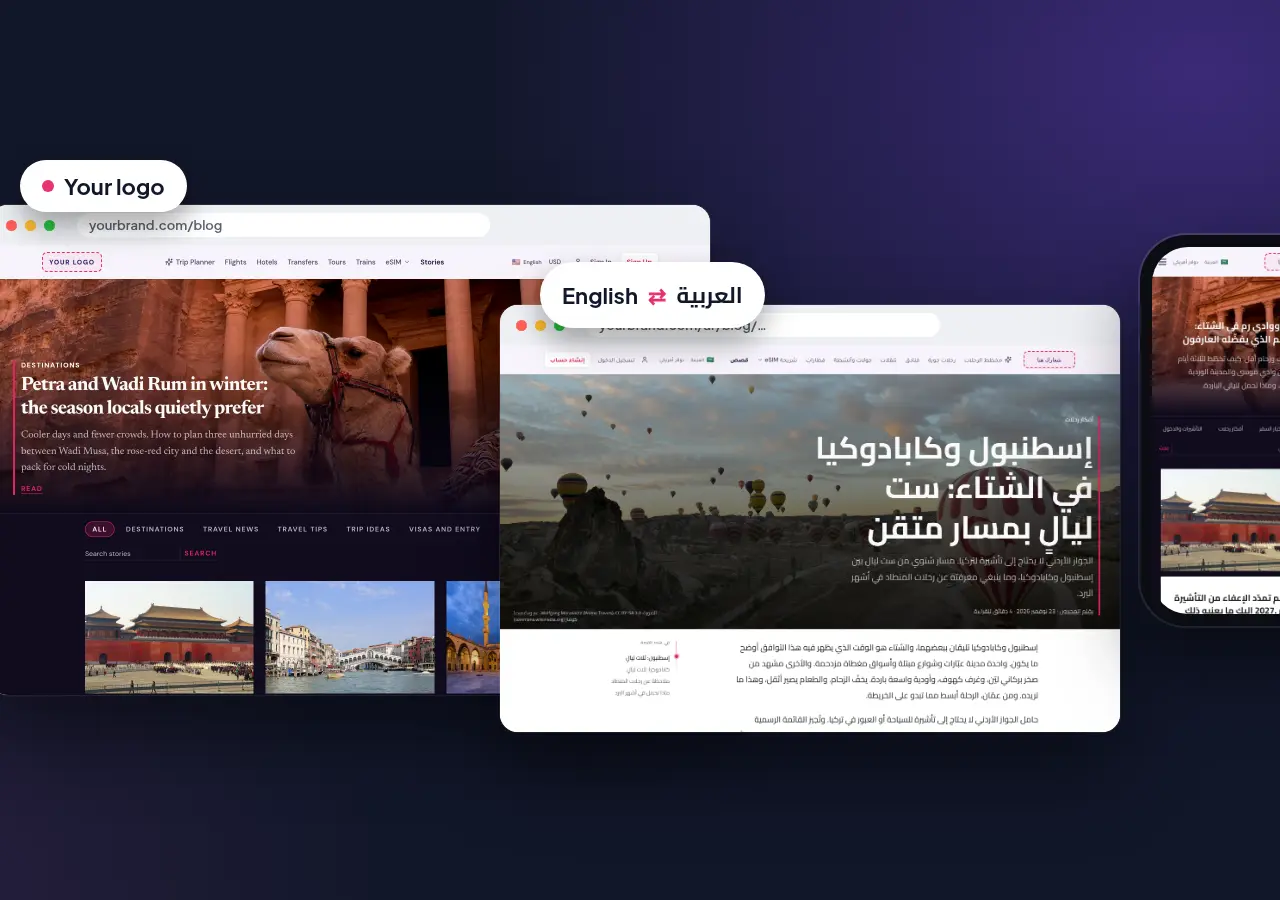
Most travel agencies already write. They answer the same visa question on WhatsApp ten times a week, post a winter route on Instagram, and send a long message to a family planning Umrah. Then it's gone. The post drops out of the feed, the chat scrolls away, and nothing is left on the agency's own website to show for it.
The usual fix is a separate blog. Someone sets up a WordPress site on a subdomain, it never quite matches the booking site, and six months later nobody remembers the password. Or the articles go on Medium or LinkedIn, which helps those platforms more than it helps you.
So we built the blog into the storefront. Since 23 November, every Traviology storefront can switch on its own blog. It's free, it lives on your domain, and it looks like the rest of your site because it is the rest of your site.
What every storefront gets
The blog is included with the platform. There's nothing extra to buy, and it stays off until you turn it on.
It lives on your domain. English sits at /blog. Arabic and every other language you publish get a prefix on the same address, such as /ar/blog.
It wears your brand. Your header, your footer, your colours. A link to the blog is added to your header and footer for you. Readers see your agency, not ours. There's no Traviology branding on the reader side.
It's designed like a magazine. A featured lead story, reading time, category filters, search, an "In this story" contents list on long articles, related stories at the end, and room for big photographs with a proper photo credit.
You decide the shelves. Categories are yours to define, such as Travel News, Destinations, Trip Ideas, Visas and Entry or Travel Tips. Tags work across all the languages a story is written in.
See it live before you read further
The quickest way to judge this is to look at one. SKYPZ Stories is a travel platform powered by Traviology. Its blog has 14 stories, each in English and in Arabic, covering things like Umrah season dates, Georgia's entry rules for Jordanian passports and a six-night winter route through Istanbul and Cappadocia.
Open a story, then switch the language in the header. You land on the same story in Arabic, laid out right to left, with its own Arabic address. That's the part most agencies tell us they couldn't get from an off-the-shelf blog.
Write in the language your clients actually read
You don't need an English original. A story can start in Arabic, French or any language your storefront has switched on. When you want another version, the editor has an Add translation step that creates a linked copy with its own title, its own text and its own web address, including Arabic addresses.
Right-to-left isn't an afterthought here. The logo, menus, filters, search and the article itself all flip properly, and Arabic text is set in typefaces chosen for Arabic, not borrowed from English. The language switcher keeps readers on the same story when they change language, instead of dropping them on the home page.
For a Gulf agency writing for Arabic-speaking families, or a European operator selling to French and German clients, that means one blog, one brand and no second website to keep in sync.
From a story to a booking
This is where a storefront blog earns its place. A story can carry a published Trip Idea from your catalogue. The reader sees the ready-made trip inside the article, opens it, and carries on planning in Trip Planner on your domain, with your brand still around them.
You choose which Trip Ideas appear. So a post on Petra in winter can end in your three-night Petra and Wadi Rum trip, and an article on Ramadan travel can point to the itineraries you've already built for that season. The article does the convincing. The trip is one tap away.
Built with search in mind
We can't promise rankings. Nobody honest can. What we can do is make sure the basics are right so good writing has a fair chance:
Each story has its own title, description and canonical address in the page, so search engines and link previews know what it is.
Language versions point to each other with hreflang tags, so the Arabic and English versions of a story are read as one article in two languages, not two competing pages.
Addresses are clean and readable, in every language, Arabic included.
Category and tag pages are public, so each topic you cover builds its own page over time.
Long archives are split into pages of 12 stories, which keeps them quick to load and easy to browse.
The rest is on the writing: useful, specific and kept up to date. A visa article that was right last year can hurt you this year, so date your facts and recheck them.
Who runs it
Your team does, from the same console it already uses for bookings. The blog desk sits at /platform/blog and works like our own Insights editor:
Write and save drafts, add a cover image and a photo credit, and publish when you're ready.
Share the work. Moderators in your organisation can publish too, so it doesn't all wait on one person.
Match your brand without code. Set the colour of the category labels, the label background and the accent colour in the blog settings. Saving refreshes the live blog straight away.
No developer, no plugins, no separate hosting bill.
A simple first month
You don't need a content calendar with 40 posts. You need four good ones.
Set up four or five categories that match how you sell. Most agencies start with Destinations, Trip Ideas, Visas and Entry and Travel Tips.
Write the three questions you answer most. Visa rules for your main passport, the best season for your top destination, and what a typical trip includes. You already know the answers.
End each story with a Trip Idea that fits it, so a reader who is convinced has somewhere to go.
Translate the best one. If your clients read Arabic and English, publish both and let the language switcher do the rest.
Share the link, not the text. When the same question arrives on WhatsApp, send the story. The reader lands on your domain, next to your trips.
FAQ
Does the blog cost extra? No. It's included with every Traviology storefront, and it stays off until you switch it on.
Will readers see Traviology anywhere? No. The blog uses your header, footer, logo and colours, on your domain.
Which languages can I publish in? Any language your storefront has switched on, including right-to-left languages such as Arabic. A story doesn't need an English version first.
Do I need a developer or a separate website? No. Posts, categories, tags, translations and blog colours are all managed at /platform/blog in your console.
Can more than one person publish? Yes. Moderators in your organisation can publish as well as admins.
Can a story link to something a client can book? Yes. You can place a published Trip Idea inside a story, and readers continue into Trip Planner on your site.
See it on your own brand
If you'd like to see how the blog would look with your logo, your languages and your Trip Ideas, book a demo. Bring one question your clients ask every week, and we'll show you how it becomes your first story. You can also read the full feature overview on the storefront blog page.
See it on your brand
Flights, hotels, trains, transfers, and tours, sold under your name. One short walkthrough, then you decide.