Markup is not margin: pricing one trip honestly
Markup and margin are not the same number. A worked travel example shows what a platform share and a discount do to your real return on a trip.
A 15% markup doesn't leave you 15% of the sale. One invented trip, worked through: markup versus margin, what a platform share takes out, and what a small discount really costs.
By Traviology · Published 2026-11-18
You buy a trip for €2,000 and add 15%. You've made 15%, haven't you?
No. You've made 15% of what you paid. Measured against what the client paid, it's less, and that gap is why two agents who both "charge 15%" can have very different months.
The two numbers
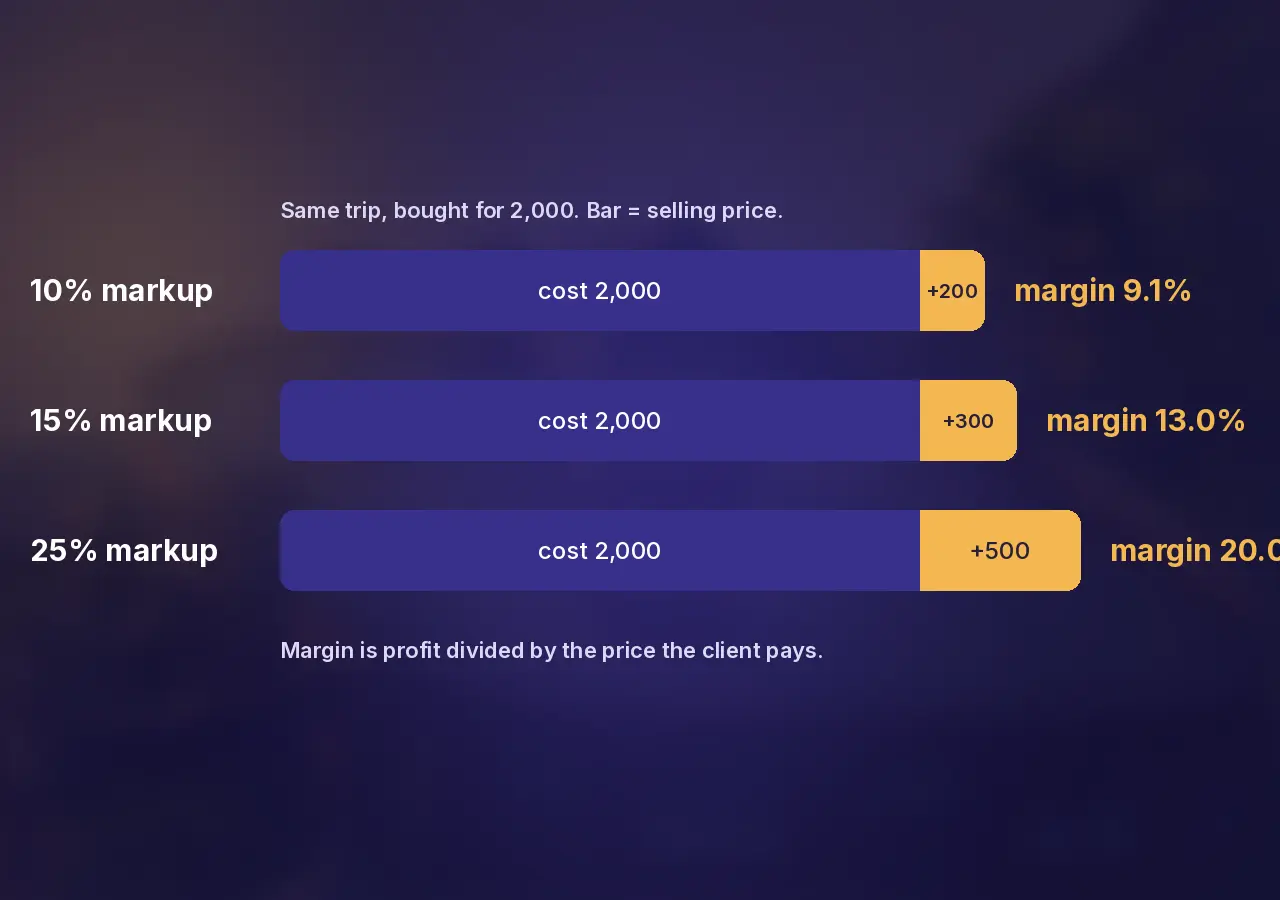
Markup is profit as a share of cost. Margin is profit as a share of the selling price. Take that €2,000 trip.
At a 10% markup you sell for €2,200 and keep €200. That's a margin of 9.1%.
At 15% you sell for €2,300 and keep €300, a margin of 13.0%.
At 25% you sell for €2,500 and keep €500. Now the margin is exactly 20%.
The shortcut is that margin equals markup divided by one plus markup. Want a 20% margin? You need a 25% markup. Agents who think in margin but set their rules in markup, or the other way round, are the ones who end up underpricing without noticing, because each number looks sensible on its own.
Then the platform takes its piece
The Platform plan takes 1.5% of completed storefront sales, plus platform fees. Enterprise is negotiable. We haven't given the fees as numbers here, because we won't quote what we can't confirm for your plan.
Assume the share is calculated on the selling price. That's our assumption, so check it. On the €2,300 sale, 1.5% is €34.50. Your €300 becomes €265.50, which is a margin of 11.5% before the platform fees and before whatever it costs to take a card payment. Cards are taken through Stripe Checkout, and we haven't included Stripe's charges because they depend on your account.
Put that way, the question changes. It isn't "is 15% enough?" It's "what's left of it?"
A discount costs more than it looks
A client asks for 5% off. On €2,300 that's €115.
It doesn't feel like much. Yet your gross markup was €300, so €115 is a bit over a third of it. The sale goes through, the client is happy, and the week's work is paid at about three fifths of what you planned.
Sometimes that's the right call. Just make it knowingly, and not because the client asked nicely.
Currency, quietly
If your supplier cost and your selling currency differ, a margin you worked out on Monday can move by Friday. Currency and markup rules are shared across the whole storefront, including the Trip Planner, so you only decide the approach once. The decision itself is still yours. A small buffer in the markup, or more frequent price reviews? Pick one.
Where the numbers live
In the Trip Planner the running total moves as you attach each flight, hotel, train, transfer or tour to a leg, which makes it easy to see what you're about to quote. It's far less useful if you haven't decided in advance what return you need on a trip like that, so write that number down first and then build the trip to match it.
One habit worth stealing: before you send any quote, say the margin out loud, not the markup. It takes five seconds and it catches more errors than a spreadsheet does.
You'll find the plan details on the pricing page, and the Trip Planner is described on the Trip Planner page.
Sources
This piece uses arithmetic on invented numbers and Traviology's own plan facts, so it has no external sources. Plan details checked October 2026.
See it on your brand
Flights, hotels, trains, transfers, and tours, sold under your name. One short walkthrough, then you decide.